German election: Merkel successor Laschet’s conservatives & Scholz’s social democrats TIED in exit polls as coalition talks loom
German election: Merkel successor Laschet’s conservatives & Scholz’s social democrats TIED in exit polls as coalition talks loom
Exit polls from the German election reveal a neck-and-neck race, with the conservative CDU party of outgoing Chancellor Angela Merkel and its main Social Democrat rivals, the SPD, tied. All eyes are now on coalition talks. Read Full Article at RT.com
Exit polls from the German election reveal a neck-and-neck race, with the conservative CDU party of outgoing Chancellor Angela Merkel and its main Social Democrat rivals, the SPD, tied. All eyes are now on coalition talks.
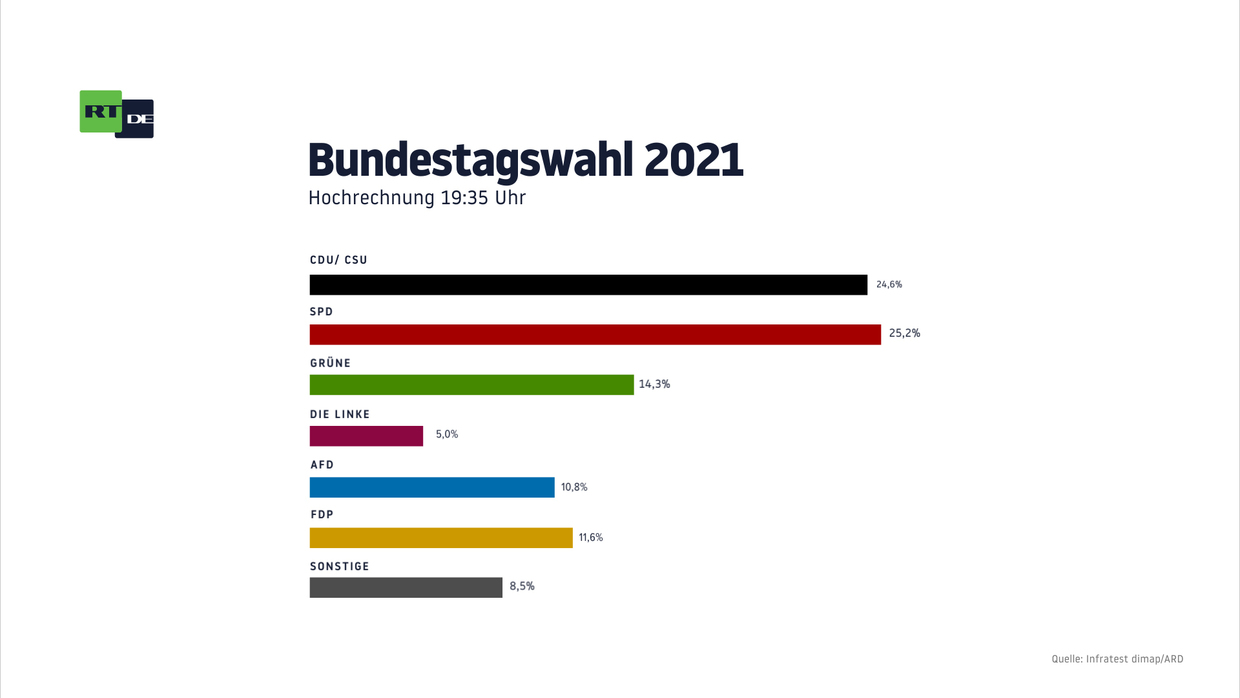
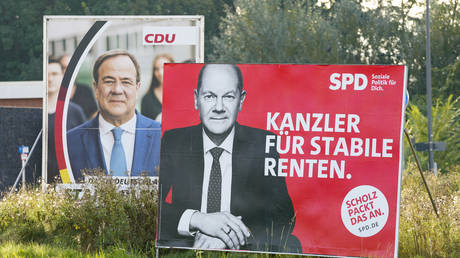
An exit poll from German broadcaster ARD shows the center-right CDU/CSU union, led by Merkel’s successor, Christian Democrat Armin Laschet, tied on 25% with the center-left Social Democratic Party (SPD), led by Olaf Scholz.
However, an alternative exit poll by TV channel ZDF has placed the SPD slightly in the lead with 26%.
The Greens were on track to get 15% of the vote, according to ARD, while the right-wing Alternative for Germany (AfD) was set for 11% – both looking close to the pre-vote predictions. Meanwhile, a potential ‘kingmaker’ in the race, the classic liberal Free Democratic Party (FDP), was also looking on course to get 11%.
The Left Party (Die Linke) was shown to be underperforming compared to earlier polling results, appearing likely to secure 5% of the vote.
Despite varying poll results, Secretary-General of the SPD Lars Klingbeil has predicted a victory for his party, telling the media, “We have the mandate to form a government,” in which “Olaf Scholz will become chancellor.”
The Greens have also been congratulating the SPD, with the party’s secretary-general, Michael Kellner, saying he is open to negotiating with all democratic parties to build the nation’s next political coalition.
Paul Ziemiak, secretary general of the CDU, has been less willing to accept an SPD victory, however, telling broadcaster ARD that it’s going to be a “long election night” and a coalition between the CDU, the Greens, and the FDP could still be on the cards.
“A coalition of the CDU, FDP and Greens would be a real future coalition – for modernization, sustainability and stability,” Ziemiak posted to Twitter.
CDU’s Chancellor candidate Armin Laschet addressed party members on election night and admitted they were not satisfied with the results, but promised the CDU would do everything it could to lead a three-party coalition, which he said would be a big challenge for the nation.
Whichever party ends up winning, the fight to claim the lead in a coalition could take months to resolve, especially with both the CDU and SPD claiming that it is they who’ll be heading it up.
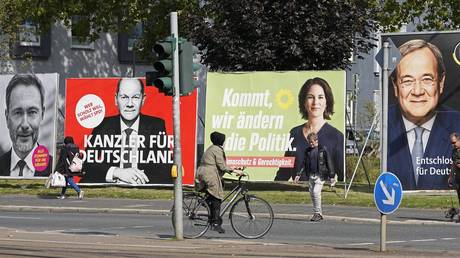
The coalition scenarios floated by experts include the so-called ‘traffic-light’ coalition – referring to the colors representing the three parties – which would be made up of the SPD, the FDP, and the Greens, cutting out the more conservative CDU. It would be led by SPD Chancellor candidate Olaf Scholz, and the Greens are already viewed as likely to form a partnership with the Social Democrats.
Tonight in #Berlin: Coalition options like a modern painting. I feel with you, @wnglucroft.
The ‘Jamaica’ scenario is also possible – made up of the CDU, the Greens, and the FDP, it would cut out the SPD and uphold the CDU’s promise that it would remain the leader of the nation’s next coalition.
The third scenario, the ‘Grand Coalition’ – a partnership between the CDU and the SPD (and possibly the Greens) is the least likely, as the Social Democrats have already worked in a junior coalition capacity during the years Angela Merkel has been in charge.
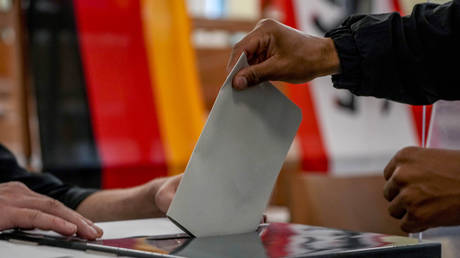
Germans went to the polls on Sunday to decide on the makeup of the Bundestag, the lower house of the country’s parliament.
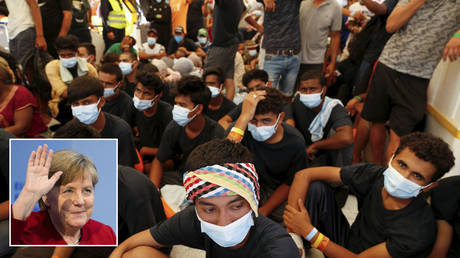
The results will determine who replaces the CDU’s Angela Merkel as chancellor. Germany’s second-longest-serving leader in the modern era, she has governed the country since 2005. She presided over the eurozone crisis, the influx of migrants from the Middle East and Africa, and the rise of extremism and terrorism in Europe.
Merkel’s eventual successor and their new government will be tasked with steering the country’s economy towards recovery after the Covid-19 pandemic and the devastating floods in Germany this summer.

 admin
admin