As US attention drifts, India and Japan move closer
Tokyo and New Delhi are expanding ties in defense, infrastructure and critical minerals to protect their long-term interests Read Full Article at RT.com
 admin
admin
Economic logic and geopolitical unease are pushing Tokyo and New Delhi into closer alignment as Washington sends mixed signals across Asia
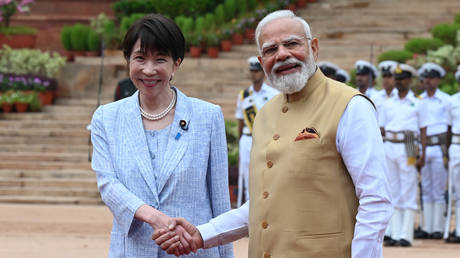
The recent visit by Japanese Prime Minister Sanae Takaichi to India came at a moment when the politics of the Indo‑Pacific appear to be in flux, especially amid rising tensions in the Middle East between the US and Iran.
With Washington increasingly tied down by its involvement in the Middle East, as well as in “its hemisphere” through aggression against Venezuela and threats against Cuba, observers on the other side of the globe are questioning what role the US can still play in an evolving Indo‑Pacific landscape – whether in the Taiwan Strait or the Strait of Malacca.
Relations between India and Japan have picked up ever since the then-Japanese Prime Minister Yoshiro Mori paid a visit to India back in 2000. Ties improved particularly during the term of Shinzo Abe, who was a big friend of India and was also the longest serving prime minister of Japan.
To understand Tokyo’s outlook towards ties with New Delhi we need to take a closer look at the current economic and political landscape in and around Japan.
Takaichi has been reaching out to a range of countries ever since taking office as prime minister in October 2025. New Delhi holds a prominent place in Japanese foreign policy, both politically and economically. At the same time, Japan’s trade ties with China appear to have run into difficulties amid rising political tensions, especially given that Takaichi is seen as a protégé of former Prime Minister Shinzo Abe, who was widely regarded as a hardliner on China.
Takaichi ran into trouble with China early in her term when, during a meeting in the lower house of Japan’s Diet in November last year, she said that if China were to impose a naval blockade on Taiwan, it would amount to a “survival-threatening situation” and could prompt Japan to exercise its right of collective self-defense. The remark drew strong protests from Beijing.
In addition, profit margins for Japanese companies in China are shrinking rapidly because of tighter regulations, rising competition from domestic firms and higher wages. By contrast, India – with its population of 1.4 billion and its vast youth demographic – fits the bill, especially as Japan’s own population continues to shrink rapidly.
Economic drivers
Japan has played a critical role in India’s infrastructure development. One of the flagship projects is the Mumbai–Ahmedabad high‑speed rail corridor, modelled on Japan’s famed Shinkansen system. As New Delhi plans to roll out a series of high‑speed rail corridors, Japanese technology and support will remain crucial.
India is a very important market for Japan’s high‑speed rail sector, especially after countries such as Indonesia chose an Indonesian–Chinese consortium over Japanese bidders for the Jakarta–Bandung high‑speed railway. It is also worth noting that both India and Japan have stayed out of the China‑led Belt and Road Initiative (BRI).
Another important reason for Takaichi’s visit to India was to advance a deal on the exploration of critical minerals, especially after China imposed restrictions on exports of such materials to Japan. The joint statement issued at the end of the visit noted “the two sides reiterated their grave concerns over the use of economic coercion and non-market policies and practices, including arbitrary export restrictions that may lead to supply chain disruptions, particularly in critical minerals and critical industrial sectors, and price manipulation.”
At the summit, the two countries agreed to advance cooperation based on three priority areas: defense and security cooperation; economic partnership; and people-to-people exchanges.
In what can be seen as a dig at Beijing and its activities in the region, the two sides expressed “serious concern” over the situation in the East China Sea and the South China Sea. They reiterated their strong opposition to any “unilateral actions” that endanger the safety and freedom of navigation and “attempts to change the status quo by force or coercion.”
In the field of security, the two countries agreed to co-develop a naval radio antenna based on Japan’s UNICORN (Unified Complex Radio Antenna) system. The agreement signed by the two prime ministers is important in light of the relaxation of Japan’s strict arms exports rules by the Takaichi administration, a major turnaround for post-war Japan. Notably, a decade ago, New Delhi and Tokyo were in talks for the sale of Japan’s ShinMaywa US-2 aircraft, but a deal never materialized.
Expanding cooperation is in the interests of both nation for a reason. Both depend on China for critical minerals, manufacturing parts, and everyday consumer goods.
Japan’s bilateral trade with India totaled only $27.4 billion during FY 2025-26. India ranks 14th in Japan’s total trade with a measly 1.75% share. Meanwhile, total trade between Japan and China stood at $292.6 billion in 2024, with China being Japan’s largest trade partner. For India, too, China emerged as the largest trading partner in 2025-26, with bilateral trade crossing $151 billion.
The larger picture
Japan and India have an important role to play in maintaining peace and stability in the Indo-Pacific, hence one of the important priorities for both nations would be to set the Quad (the Quadrilateral Security Initiative, a grouping of Australia, India, Japan, and the US) back to order.
A summit of Quad leaders has been pending for a long time. Even the recent meeting of Quad foreign ministers in New Delhi in May of this year failed to produce a date for a leaders summit.
The Quad appears to have lapsed into near oblivion because of growing dissonance among its members and the broader thaw in US-China relations, as reflected in President Donald Trump’s recent visit to China. On top of that, Washington has been preoccupied with developments in the Middle East and the multiple tariff wars it has unleashed across the world. Given Trump’s “on‑again, off‑again” approach to ties with India, sustaining the Quad could become increasingly difficult.
Japan, for its part, remains closely tied to China economically, even as it is a formal US ally. This is true not only in terms of bilateral trade, but also because large numbers of Chinese tourists visit Japan and have become an important pillar of its tourism economy. It is therefore unlikely that Tokyo would upset the applecart in Sino‑Japanese relations for the sake of the Quad.
Both India and Japan are treading an uncertain path as the US under the Trump administration has become increasingly unreliable. In Japan, many are preparing for a scenario in which the country will have to shoulder far greater responsibility for its own security. Adding to these concerns, Washington last month dropped the word “Indo” from the name of its Indo-Pacific Command (USINDOPACOM), reverting to the earlier title of Pacific Command (USPACOM). The move has stirred debate in New Delhi’s strategic circles about what it signals for India’s place in Washington’s foreign policy.
It increasingly appears that Washington’s calculations vis-à-vis Beijing do not align with those of Tokyo or New Delhi. That is one of the key reasons India and Japan are exploring closer cooperation. Under Trump, Washington seems to be leaning toward a kind of G2 arrangement centered on the US and China alone, which would leave countries like Japan particularly vulnerable, given their reliance on US security guarantees. What does seem certain is that India and Japan will see a growing convergence of interests in the Indo-Pacific.