Indian capital to pay $1,000 to scrap old cars for EVs in fight against pollution
Delhi has rolled out a major policy to incentivize the adoption of electric vehicles, offering a $1,000 cash subsidy Read Full Article at RT.com
 admin
admin
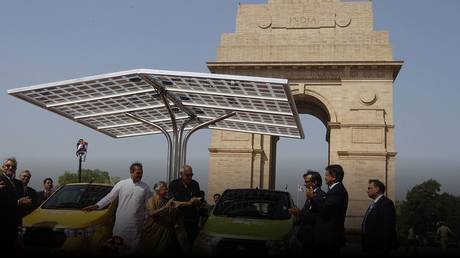
Delhi, the world’s most polluted capital city, has announced a policy to incentivize the adoption of electric vehicles jay
India’s capital has announced cash incentives for car owners to scrap their old cars for electric vehicles, as it scrambles to curb the alarming pollution levels.
The government of Delhi state has earmarked $1.59 billion over the next four years under a policy initiative to boost electric vehicles.
Delhi retained its distinction as the world’s most polluted capital city for the eighth consecutive year in 2025, according to the World Air Quality Report. The city has 8.76 million registered motor vehicles, and the new policy targets a minimum 30% electrification by March 31, 2030.
Under the policy, a $1,060 scrapping incentive will be offered to owners ready to trade in cars bought before April 1, 2020 for an electric car.
Additionally, electric cars priced up to around $31,700 will be exempt from road taxes and registration fees. These costs usually account for 4%-10% of a car’s on-road price.
The Indian capital wants a swifter energy transition for two-wheelers, of which it has 5.9 million. Delhi will only register electric two-wheelers from April 1, 2028.
The city will also offer a subsidy of around $300 to electric two-wheelers in the first year, reducing the amount by around $100 each in the next two years, to speed up the transition.
However, owners of hybrid vehicles will not benefit from these incentives.
Also, the city will only register electric autorickshaws – three-wheel vehicles – from January 1.
Delhi’s ambitious energy transition plans could, however, face difficulties as the city only has around 3,100 charging stations and 893 battery swapping stations – so the policy also includes the setting up of 32,000 EV charging points across the city.
Delhi Chief Minister Rekha Gupta, from Prime Minister Narendra Modi’s Bharatiya Janata Party, described the policy as a major step toward making the state pollution-free by March 31, 2030.
The land-locked city has high levels of pollution all year, but air quality worsens in the winter as dense, stagnant air traps smoke from crop burning in neighboring farming states, adding to vehicular emissions and dust emanating from widespread construction work.
A recent analysis based on government data found that people in Delhi are breathing in the equivalent of around nine cigarettes a day.
The incentives are also expected to boost the revenues of major electric vehicle players, including Tata Motors and Mahindra & Mahindra, and electric two-wheeler makers TVS Motor, Bajaj Auto, and Ather Energy.