US strike that killed Indian mariners tests US-India trust
The deadly attack in Strait of Hormuz revived old worries in New Delhi that the US still struggles to treat partners as equals Read Full Article at RT.com
 admin
admin
The attacks on merchant vessels in the Strait of Hormuz, and Washington’s blunt response, have deepened Indian distrust despite years of expanding cooperation
The recent incident of the US Navy attacking an unarmed merchant ship off the coast of Oman with two Hellfire missiles and killing three Indian mariners as a result has deeply angered Indian public opinion.
The Indian government was forced to summon the US chargé d’affaires in New Delhi twice to register a protest. What has particularly offended India is the lack of any expression of regret by the US for killing Indian nationals. Whatever the circumstances that led to this killing, some words of regret from the US were expected given the friendly relations between the two countries.
India and the US have a comprehensive global strategic partnership. Both have been cooperating to promote maritime security in the Indo-Pacific region, with regular naval exercises and membership of the Quad. A US officer is stationed in Indian Navy’s Information Fusion Center – Indian Ocean Region (IFC-IOR) in Gurugram. India maintains a reciprocal liaison officer in the US Central Command HQ in Florida as part of deepening maritime, counterterrorism, and undersea domain awareness cooperation.
Given this level of institutional engagement, and the fact that Indian seafarers make up roughly 10% to 12% of the global maritime workforce, the risk to Indian nationals in a region that is a major source of oil and gas not only for India but for Asia as a whole should have prompted the discussion and development of clear protocols to protect their lives.
Beyond that, US sanctions on Iran have no legal basis. Commercial shipping has no legal obligation therefore to adhere to the blockade though prudence would demand a careful assessment of risks involved in violating it. If individual ships, for whatever reason, were willing to take the risk of passing through the Strait of Hormuz with their transponders shut, it may be foolhardy on their part, but the question arises as to who gave the US the legal authority to fire missiles at them.
It is in this context that Indian External Affairs Minister S. Jaishankar spoke to US Secretary of State Rubio and reiterated India’s strong protest at the attacks by the US Navy in the Gulf that killed three Indian mariners. During the call, Jaishankar stated that such lethal actions against commercial shipping were not justified.
Rather surprisingly, Rubio’s response was unusually harsh and peremptory. He stressed to Jaishankar that all commercial vessels should immediately comply with orders from US forces which seek to uphold peace and security in the strait. He underscored that violations of the US blockade and the illicit transport of Iranian oil will not be tolerated.
Rubio implicitly not only justified the killing of three Indian mariners under the circumstances, but warned that this could happen again as the US will not tolerate the violation of its unilaterally imposed blockade. There is not even a pro forma expression of regret at the killing of nationals of a friendly country.
The irony of Rubio’s unyielding message to India is that two days later President Donald Trump announced the lifting of the US blockade and unhindered passage through the strait following a preliminary framework agreement with Iran. Rubio would have been aware of this development and yet he chose to respond to Jaishankar’s oral démarche in such hectoring language. This will only serve to seed more distrust in India towards the US.
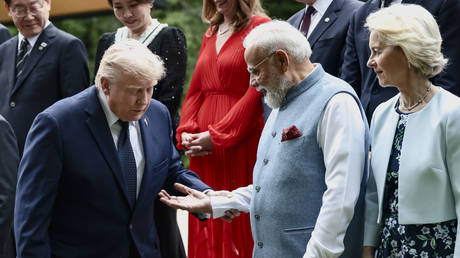
At the G7 meeting at Evian, Indian Prime Minister Narendra Modi made a point of saying in Trump’s presence that it is “our responsibility to ensure that the safety of seafarers who connect all nations through global maritime trade.” Modi asserted that countries must ensure that maritime routes remain secure and that seafarers can perform their duties “without fear.” Replying to a question from the press as to whether he had words of condolence for the grieving families, Trump said, “It [seafaring] is a rough profession, and there is no question about it.” Pointing toward Modi, he added, “We will work together on it.”
Trump evaded the issue. This "working together" could have started with some expression of regret as a demonstration of good faith. An opportunity was missed to close the matter and actually even win over Indian public opinion.
The broader context of US-India ties
The US has been building a relationship of trust with India ever since the presidency of George W. Bush. The nuclear deal with India reversed decades of mistrust between the two countries and opened the doors to an expanding relationship in several areas: economic, trade, technology, defense, and security. Presidents Obama, Biden, and even Trump in his first term continued to consolidate the relationship. India-US ties were described as the defining relationship of the 21st century.
The US has, during these years, become India’s biggest trade partner in goods and services. The Indian IT sector is closely linked to Silicon Valley in the US. After the experience of the Covid pandemic, which exposed the dependence of the rest of the world on China for a range of critical raw materials and technologies, the shift towards resilient and trustworthy supply chains was supported by India and the US.
Defense ties that were virtually absent in 2005 became a major confidence-building measure on India’s part, with New Delhi buying weapons and platforms worth over $22 billion. India and the US signed all the required foundational agreements in the defense area. India was declared a Major Defense Partner by the US and certain export control regulations were eased to allow the sale of US defense material and technologies to India.
Bilateral military exercises expanded during these years. Within the Quad, along with Japan and Australia, India and the US have been cooperating in the area of maritime security in the Indo-Pacific. The US linked the security of the Indian and Pacific Oceans, which was logical in view of Japan’s membership of the Quad. A major objective was to deter the maritime expansionism of China, though New Delhi worked to enlarge the remit of Quad to also include important non-security areas.
In the US Congress, India has enjoyed a bipartisan consensus all these years. The large Indian diaspora in the US has been valued as a strong bond. The number of Indian students enrolling in US universities overtook the number of Chinese students, hitherto the largest. India was the biggest beneficiary of the H‑1B visa scheme, and this has played a large role in strengthening links between the IT giants in the US and Indian talent.
Despite these positive trends, India-US ties have been marked by difficulties and an undercurrent of distrust. US pressure to open up the Indian economy has been relentless. During his first term, Trump was vocal on the issue of high Indian tariffs, describing India exaggeratedly as the “tariff king.”
The US has continued to be uncomfortable with India’s ties with Russia. On the defense side, Washington has made no secret it wanted to dilute India’s defense ties with Russia, and even replace Russia as India’s biggest defense partner. The CAATSA legislation passed by the US Congress, with the encouragement of Trump in his first term, was to deter India from acquiring new high-end defense platforms from Russia such as S-400 air defense missiles. This legislation put India in a defensive position to seek waivers from the Washington to avoid risks of US secondary sanctions. The US compelled India to cease buying Iranian oil under threat from sanctions. India has had to seek waivers for its operations at the Iranian port of Chabahar.
The US State Department has repeatedly targeted New Delhi in its annual reports on issues such as human rights, the treatment of minorities, and religious freedom in India – much to the annoyance of Indian opinion, which has long criticized Washington’s double standards and hypocrisy.
After Russia launched a military operation in Ukraine, pressure on New Delhi to condemn Moscow and cease buying Russian oil became contentious issues in the relationship.
While India has stood its ground, these pressures have constantly reminded India that the US is incapable of treating other countries as equals, that over dependence on the US would constrain India’s strategic autonomy which India must conserve at all costs.
In his second term, Trump has undone the progress in trust building between India and the US. From India’s viewpoint he has done this gratuitously, without any provocation from India. He has always been obsessed with high Indian tariffs, overlooking the fact that these are not US specific and are WTO compliant. He went on to impose 50% tariffs on India, the highest on any other country except Brazil, including 25% penalty tariffs for India buying Russian oil. He overlooked the fact that the Biden administration had encouraged India to buy from Russia in order to avoid a sharp spike in global oil prices.
The Trump administration has also targeted the H‑1B visa scheme. Elements within its MAGA base accuse Indian H‑1B visa holders of taking away American jobs, and some of these voices have helped fuel racist attacks on Indians. Enrolment of Indian students in US universities fell by nearly 50% last year compared with previous years.
India’s bipartisan support in the US Congress has not shielded it from Trump’s arbitrary actions. The Indian diaspora has not mobilized itself actively in the support of their homeland. The US corporate sector with large interest in India has chosen not to bat for India openly for fear of provoking the capricious Trump administration.
India has made major concessions to the US to secure a trade deal, a fact recognized by USTR Jamieson Greer, but Trump has kept it in abeyance because he wants to extract concessions from India on agricultural products in particular, which India cannot offer. He wants India to plead for a deal. He is now using Section 301 of the US trade legislation to reimpose high tariffs on India and others.
Trump has made insulting remarks about India, calling it a “dead economy” and a “hellhole.” Members of his administration, especially the commerce and treasury secretaries, have also used offensive language. Trump has further embarrassed India politically by claiming nearly 60 times that he brokered a ceasefire between India and Pakistan by threatening to use tariffs, and that he thereby prevented a nuclear war. India has officially denied this, but that has not deterred him. He appears resentful that India denied him an opportunity to bolster his case for the Nobel Peace Prize.
Trump has been strikingly insensitive to India’s concerns by politically bolstering Pakistan’s regional standing. His administration has lionized Field Marshal Munir, who is deeply hostile towards India, while drawing attention away from Pakistan’s terrorist affiliations. At the same time, it has also effectively strengthened the China-Pakistan axis by not questioning Pakistan’s high‑end arms purchases from China – as he does in the case of India’s arms purchases from Russia – even though Pakistan’s economy is in dire shape and dependent on IMF bailouts.
India’s concern is that in a bid to strengthen Washington regional military role Trump may supply US arms to Pakistan. Trump has gone to war with Iran on its nuclear program but the US ignores the expansion of Pakistan’s nuclear program, its China connection, and repeated Pakistani nuclear threats against India.
Just before the Trump-Modi meeting at Evian, the US announced that the US Indo-Pacific Command, so named in 2018 by Trump, will revert to its original name of the US Pacific Command. This erodes the salience of the Quad.
This comes after Rubio visited India in late May for the Quad Foreign Ministers meeting, with the intent to keep the group afloat. This shows some gap in thinking within the Trump administration on US maritime strategy in the Indo-Pacific area relating to China.
India, the only country with credible naval power in the Indian Ocean littoral, is an indispensable partner for ensuring maritime security in these waters through which the vital trade and energy routes of ASEAN and East Asian countries – including China, Japan, and South Korea – pass. By its uncertain messaging in the Indo-Pacific area, the US is reflecting the same kind of strategic disarray that that the Trump administration’s adventurism in the Middle East has already exposed.