Dr. Anthony Fauci pleaded the Fifth more than 100 times as Republicans grilled him on the origins of Covid-19 at a Senate hearing Read Full Article at RT.com
The former coronavirus czar pleaded the Fifth more than 100 times as Republicans grilled him on the origins of Covid-19
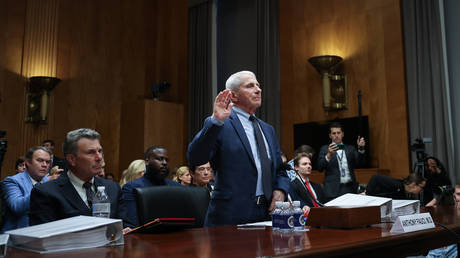
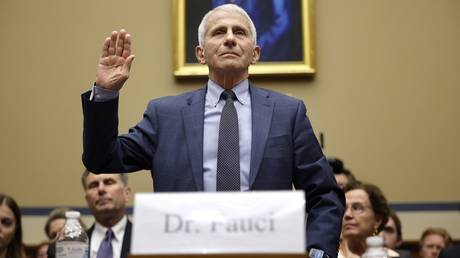
Former US Coronavirus czar Dr. Anthony Fauci was hauled before Congress on Wednesday to testify on the origins of Covid-19. Fauci repeatedly invoked his Fifth Amendment right to silence, but RT kept the receipts.
Fauci appeared before the Senate Homeland Security and Governmental Affairs Committee, in a hearing orchestrated by Senator Rand Paul. A Kentucky Republican and vocal critic of Fauci’s handling of the pandemic, Paul released thousands of pages from Fauci’s personal diaries over the weekend, which suggested that the Covid chief knew the virus did not originate in a ‘wet market’ in Wuhan, China, but insisted in public that it did.
Former US Director of National Intelligence Tulsi Gabbard has also released documents suggesting that Fauci pushed the wet market theory in meetings with the intelligence community, before denying under oath that he ever held such discussions.
“I hope today Dr. Fauci will come clean, admit it was a mistake to fund dangerous research in China, admit that the risk of this dangerous research exceeded any possible benefits, ask forgiveness, and pledge to help our government devise safeguards so a manmade epidemic never happens again,” Paul said in his opening statement at Wednesday’s hearing.
Any hopes that Paul would get answers, however, were dashed when Fauci pleaded the Fifth more than 100 times during questioning from Paul and other Republicans on the committee.
Here’s what Fauci was asked, and what the record shows.
Did Covid-19 come from a laboratory?
Fauci was asked multiple times whether Covid-19 originated in a laboratory at the Wuhan Institute of Virology; whether he was aware that the virus bore the hallmarks of gene editing; and whether he knew that the lab had more than 100 man-made viruses in storage that could have been precursors to Covid-19.
Fauci, who led the National Institute of Allergy and Infectious Diseases (NIAID) from 1984 to 2022, gave the same answer to every question: “On the advice of counsel, I respectfully decline to answer based upon my rights under the Fifth Amendment of the Constitution.”
Based on Fauci’s own diary, he believed in January 2020 that “the market was not the source, it was the amplifier.” After a call with a dozen government scientists on February 1, Fauci remarked that the group was split, with only two believing the wet market theory, and the rest believing that a lab leak was more likely. Fauci insisted on the wet market theory, and on April 17 publicly declared that the virus was “totally consistent” with a natural species jump. He reiterated this point in a National Geographic interview in May, stating “everything about the stepwise evolution over time strongly indicates that it evolved in nature and then jumped species.”
It has not been conclusively proven that Covid-19 was created at the Wuhan Institute of Virology, but the lab leak theory is now the official position of the White House.
Did Fauci fund gain-of-function research in Wuhan?
Fauci shot down any questions concerning his own role in coronavirus research in Wuhan. He has previously testified under oath that the National Institutes of Health (NIH), the parent organization of Fauci’s NIAID, did not conduct “gain-of-function” research into bat-borne coronaviruses at the Wuhan lab.
However, documents released in 2021 and 2022 prove that the NIH paid a private firm, EcoHealth Alliance, to conduct this research at the Wuhan Institute of Virology, and that some of this money was doled out even after the Pentagon’s Defense Advanced Research Projects Agency (DARPA) rejected the proposal as overly risky.
In a 2020 email, Fauci stated that he knew gain-of-function research was being carried out at the lab. The NIH’s role in funding research on bate-borne coronaviruses specifically is described in publicly available grant information, although the words “gain-of-function” are not used in the grant proposal.

 admin
admin